Monday, 30 June 2008

An Evening Lecture


In early June, I attended a lecture at my local Guild called "Textiles and Clothing in Greek and Roman Society" and here is my account of it, written for the Guild newsletter:

Dr Clemence Schultze, Lecturer in the Department of Classics and Ancient History at Durham University, visited the Durham Guild in June and gave us a fascinating insight into the history of ancient clothing. [Some additional research for this article is from the web].

Textiles in the ancient world were primarily spun and woven by women. Socially, weaving was seen as a symbol of feminine virtue and industry as depicted in the myth of Lucretia and was held in high esteem as a wifely occupation. Women worked alongside maids which led to skill-sharing between women of all ranks during their many hours at the loom. High value was placed on certain types of items such as soldiers’ clothing. One interesting difference: In Greek society, women wove privately and virtuously in the women’s quarters whereas in Rome, it was seen as a social activity and carried out publicly in the atrium.

Weaving mythology also revolved around deception and competition. Penelope, the loyal wife of Odysseus - aka Ulysses- used her weaving to keep unwanted suitors at bay in her husband’s long absence. She began weaving a shroud, saying that she would choose a suitor when it was finished. It was a trick though (and a good one, kept up for three years!) as she would secretly unpick part of the shroud at night then weave it again the next day. Another story tells of Arachne, a shepherd’s daughter, who boasted that none could match her weaving talent and challenged Athena to a competition. During the ensuing contest, she offended Athena and was ultimately turned into a spider, condemned to hang and spin for eternity as punishment. Competing with peers to determine one’s social esteem seemed to be a particularly Greek custom.

Dr Schultze discussed how information about ancient textiles and clothing was gathered, and noted the challenge of making accurate translations from Latin and Greek to gain meaningful results.

Surviving literature from the ancient era consists mainly of technical documents which give scarce mention to arts and crafts since male scholars didn’t regard them as significant. One exception was the scholar Pliny whose life’s work, the Encyclopaedia of Natural History, survived over the centuries. Pliny wrote, for example, about dyeing processes and the best sheep wools for weaving. Other records also survive from this period including those describing textile offerings made to the goddess Artemis, detailing their garment type, pattern, colour, fabric type, and form. Fibres used for weaving in the ancient world included wool, linen, silk, hair (horse, goat, human etc), cotton, hemp and other plant fibres. Knitting, however, was not known to the ancients.

Art from the period such as sculpture, mosaic, vase and wall painting gave more clues. Dr Shultze showed us a range of slides depicting clothing and women weaving at the loom. She commented that women in those days were so skilled that they were able to accurately estimate the weight of raw fibre needed to create a final garment. Original traces of paint on a ‘Peplos Kore’ statue (a statue of a girl or maiden) give clues as to the rich colours used in the fabrics. Archaeologists have uncovered valuable artefacts such as needles, whorls, bone tablets, as well as fragments of woven cloth which have escaped deterioration. Indirect evidence from archaeology - pottery with textile impressions, metalware with the trace of the textile in which it was once wrapped - also indicate spinning and weaving techniques. Additionally, warp-weighted looms were used in Scandinavia until the early twentieth century. Studies of this living tradition helped researchers understand how the looms of the ancient world operated.

Dr Schulze described some of the types of clothing worn at the time. The peplos, an overfold pinned to your shoulders, gave a blouson effect. The chiton, a tube shaped garment, had sleeves created by multiple loops, ties or toggles. Sewing was generally avoided as needles were crude. The toga was developed around 90BC. It involved a lot of cloth, the length of which was generally three times the distance from shoulder to ground of the wearer. It was a roughly semi circular shape with a woven curved border - cutting was avoided - and rank was indicated by adding a coloured border.

Unlike the Greeks, Romans used clothing symbolically: for them clothing was costume. Whereas simple clothes were worn at home, the toga was a status symbol to be worn in public. Looking dignified in such a cumbersome garment took practice. It marked one out as male (enhancing one’s physique), moneyed (you could afford someone to help you put it on), and as a free Roman citizen. Women also wore a version of the toga, a long tunic called a stola. It was generally worn over a tunica, the basic full length item of clothing worn by all women. Either garment could have an instita, or border, along its lower hem, and the palla, a type of shawl, was draped around the shoulders.

During a Q&A session, some Guild members speculated on whether men would also have woven cloth, particularly larger, heavier items such as sails, perhaps using hemp or coarse linen, and whether family businesses may have specialised in such areas.

Dr Schultze is currently teaching a new module called “Clothing the Body, Garbing the Past”. The evening finished with an invitation to Guild members to view the display of current student projects: their ‘process portfolios’ which recorded the planning, research and reflection involved in recreating items from the ancient world, as well as the dyed samples, garments, footwear and other items themselves.

Saturday, 31 May 2008

Absence from the loom

It has been eight weeks since my last entry.

Thank you for taking time since then to leave comments on my blog. Each one has felt like a little ‘energy’ present from you to me, gently encouraging and reminding me to weave. Finally, the balance has tipped and here I am again.

My life-work balance shifted over the last couple of months: a temporary increase of hours in my paid job meant the energy or desire to weave dwindled and it all quietly took a backseat. Things are now back to normal though and I am perking up again.

It highlights to me the classic question experienced by anyone pursuing a vocational activity: How do you earn enough money and feed your soul at the same time? My compromise has been to work less, weave more, and accept a lower income. It’s about choice and sacrifice: not everything is possible, but some of the good and important things are possible.

The warmer weather has led me outdoors. The sun, at last, has been making its presence known after a long damp winter and so my recent creative energy has been spent outside in the garden. I’ve been thinking about bringing the weaving outdoors by creating functional structures which form an integral part of the garden. I have been considering what materials I might use and how to make them weather resistant.

My first project is to recreate an old archway which finally collapsed during a vigorous storm several months ago. I harvested branches from a budlia at the back of the garden, which are currently strewn around, sorted into straight, bendy, forked and irregular limbs. With these, I hope to recreate the archway which the vegetation can then grow into and embrace. The idea of having a subtle, creative presence in the garden is appealing

Are these reasons not to be weaving though, I ask myself.

I have just fetched my loom out from storage to take a fresh look. The black and white design makes me think of the energy of woodcuts. I like its immediacy. I hope to create work with energy about it, intrigue and interest. The panel of circles is still on the agenda. I look forward to playing more on the warps. There is something about the realness of the materials which I find healing and reassuring: the physicality of the wood, the firm warp, the fibrous wool. What I love about weaving is the simplicity, the focus, and the quietness. I haven’t been in a very quiet and balanced place of late, and so my mind has been resistant to sitting at the loom - but I am here again, touching base.

Friday, 4 April 2008

Interplay

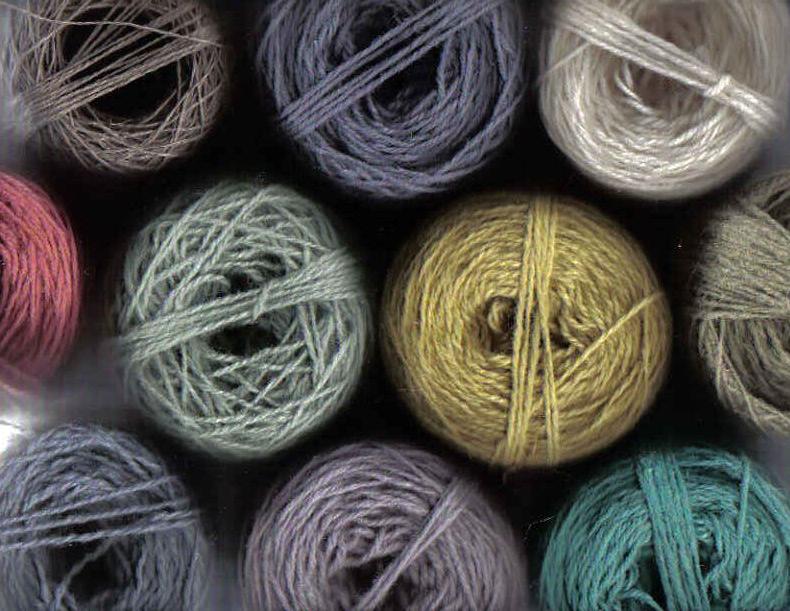
I begin by choosing the colours for the new sample. The wound balls of colours look fantastic together. Just looking at them makes me want to weave. This time however, I decide to restrict the number of colours I work with in order to focus my attention on technique and design, and choose just black and white.

I’m just going to start and see where it takes me. I have some ideas which may come to fruition but perhaps the weaving will take me in a different direction. I resolve to stick to my original plan of weaving a panel of circles, and see what happens within this structure. I might also try my hand at weaving letters and words.

I start by drawing a circle onto the warps with a permanent pen, then weaving up to its base then up one side. The result seems to be a fairly good curve which is encouraging, this being my first ever attempt at weaving a circle. It is a technical challenge to weave shapes well in a process such as tapestry weaving which is physically inclined towards horizontal and vertical elements, but this is also part of the attraction.

I like creating lines visually without them being there physically. Here, the black and white pattern gives the impression of a circle, but without using a solid outline. I very much like the idea of giving enough pictorial information in the weaving, but not spelling everything out. It then involves the viewer by allowing him or her the space to make visual connections and independent discoveries which feels so much more dynamic and interesting.

Tuesday, 1 April 2008

Circulation

I’ve set up a circular warp on the loom. This type of warp is tied to itself rather than the frame, which means that every so often I can loosen it, pull the weaving around the loom, then tighten again.

There are two reasons for this: firstly, it enables me to create a longer panel of weaving because I have a longer unbroken length of warp to work on; secondly, it enables me to keep working at the same height which is my personal preference.

Working on a circular warp means that the weaver only has access to half of the warp ends (those on the front of the loom). Normally, the warps at the front and back of the loom would be brought together and secured with a starter weft. This would then double up the warps to be woven on. Therefore, to achieve the usual sett (the number of warp ends per inch) that I am accustomed to, I wind double the number of warp ends onto the frame when creating a circular warp.

Additionally, I like to fix a spacing rod to the top of the loom before I start winding on the warp. I do this as a matter of course as it gives me the option of some slack if required later by adjusting its position. Likewise, I often create a double warp at the selvedges (the edges of the tapestry) for strength, stability and structural punctuation.

Before weaving, I finish the setting up process by doing the following:

  • tying on a temporary starter weft to stabilise the base of the warps which will be cut off when the tapestry is pulled around for the first time.

  • clamping a wooden baton inside the base of the front warp, a foundation for the heading and base knots to follow.

  • weaving two inches of heading (which spaces the warps evenly, and is removed after the tapestry is cut off the frame)

  • adding a row of base knots – this secures the tapestry to the warps and stop the weft slipping down the warps.

  • creating a shed (the space between the front and back warps) by inserting a dowel rod into the warps, secured in place with metal g-clamps (plastic clamps distort under tension)

My weaving memories are making a gradual return. Knowledge gained from the experience of past tapestries is filtering back (hooray) and I pick up where I left off. It feels lovely, valuable and reassuring, all rolled into one.

Monday, 31 March 2008

Glossary

The glossary below will be continually updated. Access it any time via the link to the right of the page.

Base knots: two half hitch knots tied onto each warp end before weaving commences (and also at the end when the weaving is finished). Along with the starter weft, this creates a firm base to weave onto. The knots remain as part of the tapestry when it is cut off the frame, and prevent the weft unravelling.

Heading: temporary, thicker weft woven between the warps in order to space the warps evenly before the base knots are applied. It does not form part of the tapestry and is later removed.

Sample: a piece of experimental weaving, not deliberately intended as a finished tapestry

Sett: the number of warp ends per inch (epi)

Shed: the space formed between the front and back warps. There are two sheds - the open shed (created naturally), and the closed shed (created by pulling the back warps forwards between the front warps)

Starter weft: Strong weft, usually warp thread, tied to the frame and woven between the warp threads two or three times, pulled taut and tied off. This secures the warp threads in place before weaving commences and gives a firm foundation, along with a row of base knots. The starter weft is removed after the tapestry cut off the frame.

Warp: the taught vertical threads, usually cotton or linen, made by winding the fibre around the frame. Warp thread is different to string - it is specifically designed to be firm and strong but with some springy-ness to allow the weaver to manipulate the warps during the weaving process. The weaver may wish to experiment by using other sturdy fibres (such as fishing line or wire) as warps.

Weft: the horizonal threads, woven between the warps, and usually packed down to cover the warps completely, although this depends on the intention - the weaver may want to leave the some warp threads exposed. Any fibre element which can be woven between the warps can be used as weft.